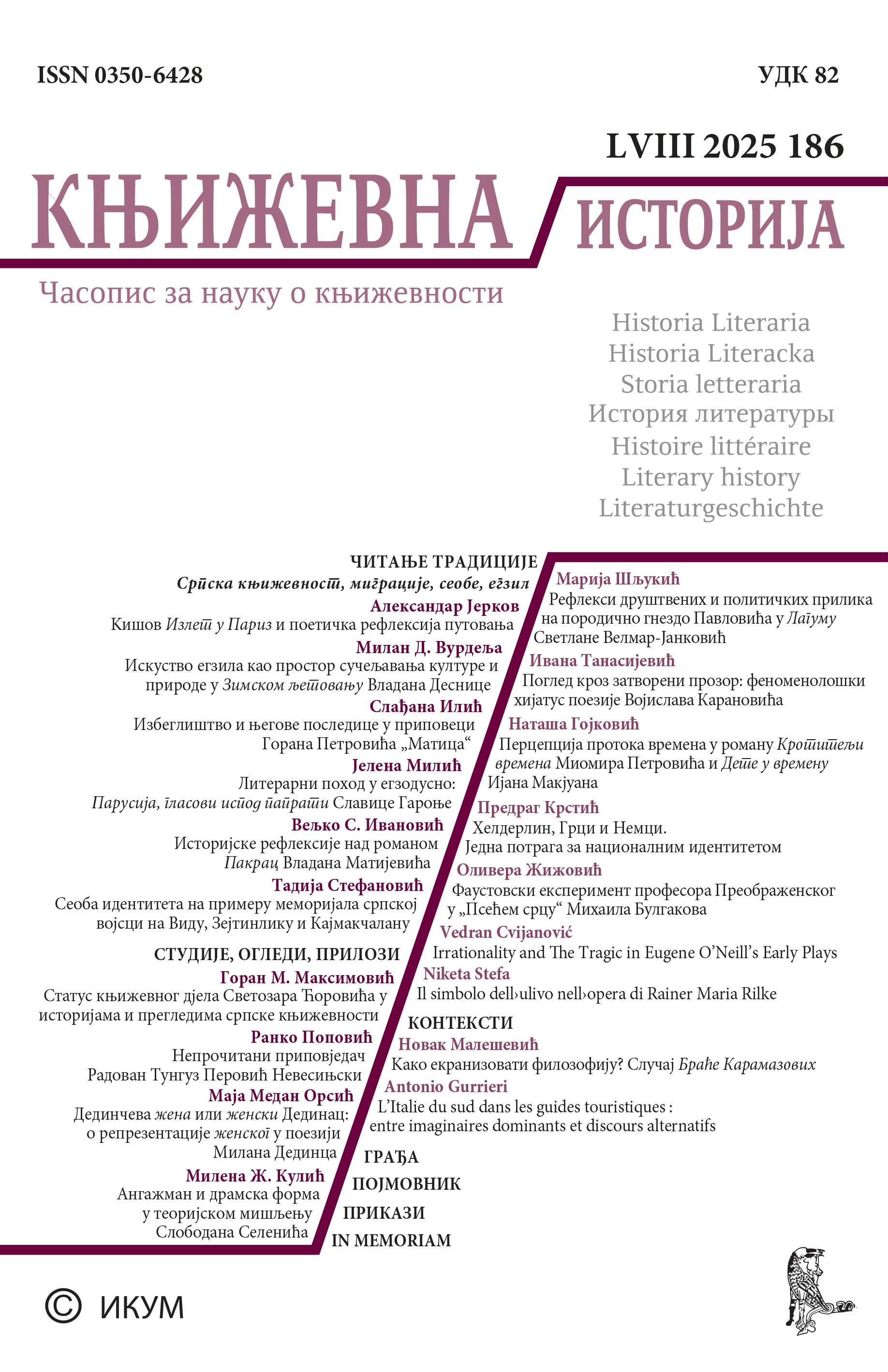
Irrationality and the Tragic in Eugene O'Neill's Early Plays
Сажетак
This paper presents irrationality as one of the key dramatic features in selected early plays by Eugene O’Neill, arguably the most significant American dramatist of the early 20th century. In these works, irrationality emerges as an uncontrollable force governing the behavior of his characters and ultimately shaping their often fatal actions. The interpretative analysis indicates that irrationality serves as a central driving force behind the dramatic impact of O’Neill’s early plays and functions as a threshold to the tragic, which pervades his dramatic vision.
Референце
Diggins, John Patrick. Eugene O’Neill’s America: Desire Under Democracy. Chicago: The University of Chicago Press, 2007.
Dowling, Robert M. Eugene O’Neill: A Life in Four Acts. New Haven and London: Yale University Press, 2014.
Eisen, Kurt. The Theater of Eugene O’Neill: American Modernism on the World Stage. London – New York: Bloomsbury Publishing, 2018.
Gelb, Barbara and Arthur. O’Neill. New York: Dell Publishing, 1965.
Westgate, Chris J. “Rethinking O’Neill’s Beginnings: Slumming, Sociology, and Sensationalism in The Web”. Michael Y. Bennett, Benjamin D. Carson (eds.). Eugene O’Neill’s One-Act Plays: New Critical Perspectives. New York: Palgrave Macmillan, 2012.
O’Neill, Eugene. Complete Plays, 1913–1920. Travis Bogard (ed.). New York: The Library of America, 1988.
Wellek, René. A History of Modern Criticism: 1750–1950. Vol. 6: American Criticism, 1900–1950. London: Jonathan Cape, 1986.
Wynstra, Beth. Vows, Veils, and Masks: The Performance of Marriage in the Plays of Eugene O’Neill. Iowa City: University of Iowa Press, 2023.
Сва права задржана (c) 2025 Vedran Cvijanović

Овај рад је под Creative Commons Aуторство-Nекомерцијално-Без прераде 4.0 Интернационална лиценца.
Аутори који објављују у часопису сагласни су са следећим условима:
- Аутори задржавају своја ауторска права и додељују часопису ексклузивно право првог објављивања научног рада који је истовремено лиценциран под Creative Commons Attribution-NonCommercial-NoDerivatives 4.0 International (CC BY-NC-ND 4.0), што омогућава другима да деле ту интелектуалну својину искључиво у научноистраживачке сврхе уз одговарајуће цитирање на аутора и часопис.
- Аутори имају права да деле своје радове у одговарајућим институционалним репозиторијумима, као и да их накнадно објављују прерађене и уз дораду, али уз обавезну потврду Књижевне историје и напомену о првом објављивању у овом часопису.
- Ауторима је дозвољено, чак се и подстичу да деле радове вирално (нпр. на друштвеним мрежама попут ResearchGate или Academia), што може довести до продуктивне размене научних информација, као и до веће видљивости и цититираности аутора и часописа. (Погледајте The Effect of Open Access).